Relationship Advice
Long-Distance Relationships with Truckers
Video call strategies, scheduled check-ins, and how to handle the re-entry period when they come home.
Read the guideDating a long-haul trucker isn't like dating someone with a 9-to-5. It's a relationship built across 800 miles, spotty cell signal, and a schedule that shifts every dispatch call. Here's how partners make it work - without losing their minds or their independence.
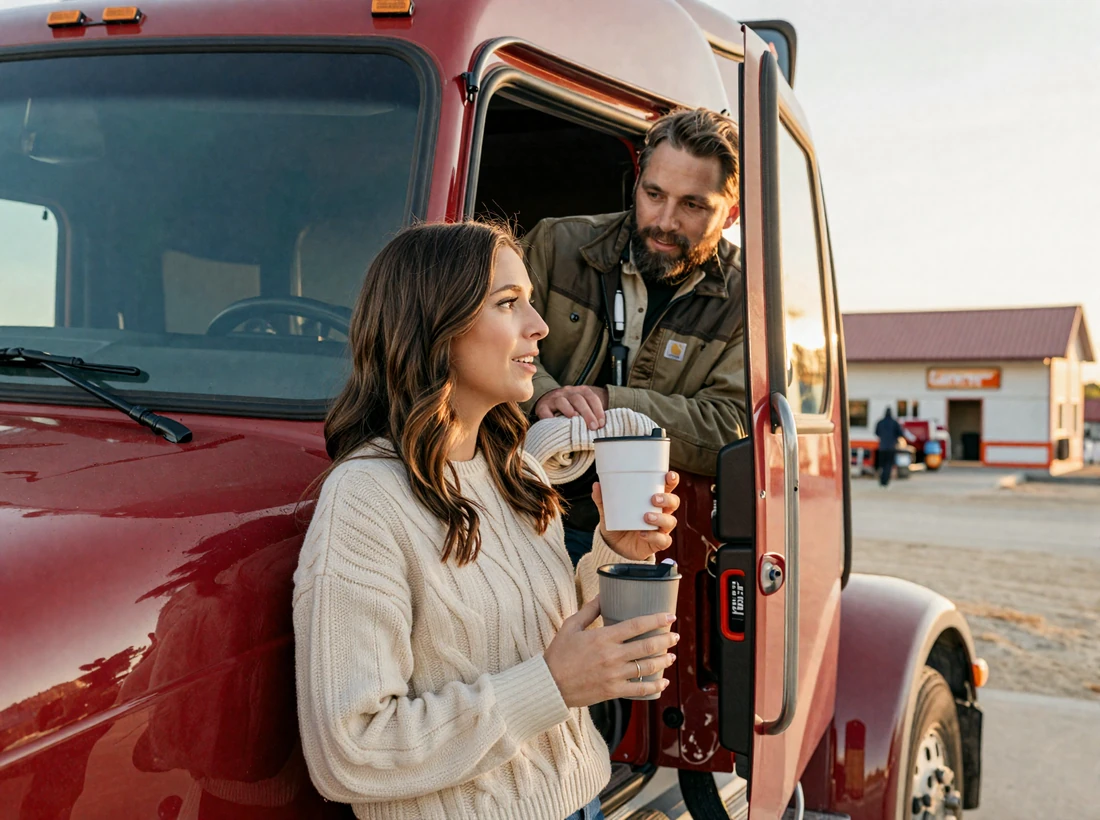
Dating a truck driver means accepting from day one that you are dating someone whose schedule is set by Hours of Service regulations, dispatch, weather in Wyoming, and a shipper who didn't load on time in Laredo. Long-haul drivers are typically away from home for two to three weeks at a stretch, followed by a few days off - sometimes less if a high-paying load comes through. According to relationship experts at Women in Trucking, happy couples typically need at least 2 hours per day and 15 hours per week together. For an over-the-road (OTR) driver, that benchmark is mathematically impossible most weeks.
Here's the thing: that doesn't mean the relationship is doomed. It means the relationship runs on different math. Ellen Voie, President and CEO of the Women in Trucking Association, puts it plainly:
When dating a truck driver, the person at home needs to understand first that the driver will be away from home for periods of time - missed holidays, anniversaries, birthdays and the inability to RSVP for a wedding. Ellen Voie - Women in Trucking Association
If you read that and your first reaction is "that's a deal-breaker," that's useful information - for both of you. If your reaction is "okay, then we celebrate the anniversary in a Cracker Barrel parking lot when you're back through," you're probably going to be fine. The honest answer to is it hard to be in a relationship with a truck driver is yes, but the difficulty is predictable, not chaotic. That's what makes it survivable.
Most trucker relationships don't fail because of cheating or distance - they fail because nobody set a communication rhythm in the first three months. The good news: a workable rhythm only takes four habits. Here's what successful trucker couples do, drawn from Prime Inc. drivers, the TruckersReport community, and 2025 advice from LuckyTruck.
Pick a 90-minute window (say, 8:00-9:30 PM Central) when one or both of you tries to be available. Spotty signal in rural Nebraska kills hard appointments. A window survives a fuel stop in the middle of nowhere.
Voice notes are one-handed, hands-free, and they carry tone. A 30-second voice note from a Pilot in Indiana reads as warmth. A three-word text reads as distance, even when it was meant kindly.
FaceTime or Skype once parked for the night. Make it the same evening every week. Seeing each other beats reading each other - even a 12-minute call lowers the loneliness spike that hits drivers around 9 PM.
A sunrise photo from the cab. A picture of the gas station coffee. A meme about dispatch. The point is presence in each other's small moments - not depth. Depth comes home time.
One thing to skip: stress-dumping the moment you reconnect. Both of you have had a hard day. Save the heavy conversations for the second call of the evening, or for the second day of home time when the adrenaline of arrival has worn off.
Home time is precious and short. The mistake almost everyone makes the first year is treating it like a normal weekend - running errands, catching up on laundry, then suddenly the truck is rolling out again at 4 AM Monday and you haven't actually been together. Plan home time the way you'd plan a short vacation, because functionally it is one.
A few practical anchors that experienced trucker couples swear by:
If you're new to dating someone who runs OTR and want a deeper look at what their days actually look like, read Life on the Road and Dating - it walks through a real day from inside the cab.
Trust is the number-one factor in trucker relationship survival, according to every advisor we've consulted - and it has to be built deliberately because the natural conditions of OTR life (long absences, anonymous truck stops, a phone that goes silent in dead zones) all work against it. Maria Hafner, who runs Confessions of a Trucker's Wife, doesn't soften it:
The most important thing you need is trust and communication. Without this, you cannot date a truck driver.

Trust gets built in small, consistent moves. Send a quick "parked for the night, all good" text every evening. Mention the dispatcher's name. Mention the shipper. Make the day visible. On the partner-at-home side, the same applies in reverse: keep them in your daily life with photos, plans, the dog being weird. The relationships that struggle are the ones where both sides go silent for hours and let imagination fill the gap. Imagination is rarely kind.
If something feels off - a profile you matched with that doesn't add up, money requests, refusal to do a video call - read our safety tips before you invest emotionally. Romance scams specifically target the trucker dating space.
Drive My Way's coverage of trucker dating notes that the lifestyle - long hours, sleeping at truck stops, limited personal time - makes "the prospect of dating daunting." Most of the avoidable damage comes from a few specific patterns. Here are the pros and cons of dating a truck driver, condensed into things to skip versus things to lean into.
| Don't | Do Instead |
|---|---|
| Take silence personally during a 14-hour shift | Assume they're driving safely; expect a check-in at the next stop |
| Build your social life entirely around their home time | Keep an independent routine - friends, hobbies, plans |
| Save every hard conversation for the phone | Hold heavy talks for video calls or in person at home |
| Treat last-minute schedule changes as broken promises | Treat them as HOS reality; keep flexible backup plans |
| Stress-dump the moment they walk through the door | Give a one-hour decompression buffer after arrival |
| Date a trucker hoping they'll quit driving for you | Date a trucker who loves their work and respects yours |
The last one is the big one. Drivers who feel pressured to leave the industry by a new partner almost always end up resenting either the job or the partner - sometimes both. The relationships that last are the ones where both people walked in respecting the lifestyle.
Straight answers to the questions people search before they DM us.
Yes - but it is manageable with the right partner and tools. The difficulty is predictable: 2-3 weeks apart, last-minute schedule changes, and limited daily contact. Couples who agree on a communication rhythm early and protect home time as intentional couple time consistently report stable, long-term relationships.
The first three months are the steepest learning curve. New partners often misread silence (a 14-hour shift) as withdrawal. Once you understand Hours of Service regulations and adopt a daily check-in window, the rhythm becomes predictable. Most experienced trucker partners say year two is dramatically easier than year one.
Pros: stable income, real independence in your own daily life, intense and intentional home time, a partner with strong work ethic and self-reliance. Cons: 2-3 weeks of physical separation, missed holidays and events, irregular schedules, and the re-entry adjustment when they come home. The pros and cons are clear - what matters is whether they fit your temperament.
For most over-the-road drivers, expect 2-3 weeks on the road followed by 2-4 days home. Regional and dedicated route drivers can be home weekly or even nightly. If consistent daily contact matters more than mileage pay, dating a regional driver is a meaningfully different experience from dating an OTR driver.
The best trucker dating site is one that is mobile-first, lets you browse real profiles before any paywall, supports voice notes and asynchronous messaging for spotty signal, and has CDL or driver verification. RoadHeart was built around exactly these constraints - free to join, free to browse, and designed for evening-at-the-truck-stop usage patterns.
Trust is built through small daily transparency: a check-in when parked for the night, occasional voice notes about the day, mentioning dispatchers and shippers by name. The relationships that struggle are ones where long silences let imagination fill the gap. Consistency matters more than length.
Video call strategies, scheduled check-ins, and how to handle the re-entry period when they come home.
Read the guideWhat OTR life actually looks like from inside the cab - and how dating fits into 500-mile days.
Read the postBrowse trucker dating by state - Texas, Iowa, Wyoming and 8 more - to find people running routes through your area.
Explore by state