Match logic
Route Compatibility, Not Radius
Profiles show home base and regular corridors. The match engine surfaces people whose lanes overlap yours over weeks - not whoever is within 50 miles tonight.
Tinder for truckers sounds like a punchline, but the structural problems are real - and they bury CDL profiles in the algorithm before a conversation even starts. Here's a clear-eyed look at why mainstream apps fail OTR drivers, and what a platform built for the road does instead.
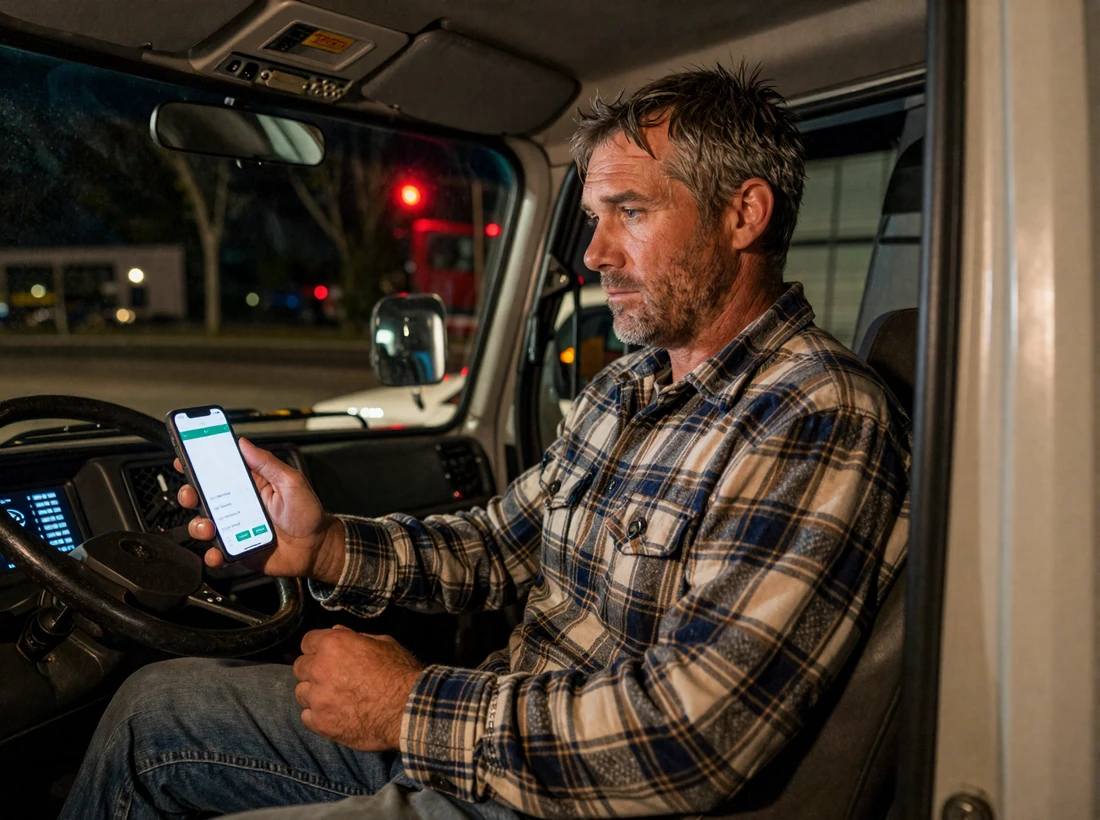
Mainstream dating apps are built around two assumptions that break for truck drivers: that users can reply within minutes and meet within days. According to Lovezoid's 2026 platform testing, that single design choice systematically buries the profiles of anyone who drives for a living. The result is what looks like a personal failure - no matches, no replies, ghosted conversations - but is actually a structural mismatch between OTR life and consumer dating tech.
Standard dating apps use a static location pin. That works fine for someone whose week happens within a 15-mile radius. For a long-haul driver who is in Ohio on Monday, Texas by Thursday, and back through Indiana the following Tuesday, that single pin is essentially fiction. You set your location to "home base," and the app shows you matches in a city you might not see again for 19 days.
You can manually update your location at every stop, but that strategy backfires fast. New conversations open in Amarillo while you're already gone. Matches in Pennsylvania reach out three days after your trailer rolled out of Harrisburg. The radius is technically correct and practically useless - what drivers actually need is route-aware matching, where the system understands your regular corridors and home state, not just where your truck is parked tonight.
The deeper issue: distance is treated as a deal-breaker by default. Most apps will not show a profile that sits outside a 50-mile radius even if both users would happily talk for two weeks before meeting. The algorithm prioritizes immediacy. Drivers operate on delay.
Every major dating app tracks how fast you respond, how often you open the app, and whether you initiate conversations. Those signals feed a ranking system that decides who sees your profile. A driver who replies eleven hours later because he was actually driving - the entire point of his job - gets flagged as "low engagement" and quietly demoted in the feed.
This is not a conspiracy theory. It's how recommendation engines work. The app's goal is to keep both sides of a conversation active so neither user gets bored and uninstalls. From that lens, a person who goes dark for 14 hours twice a week is a liability. So the algorithm responds by showing the profile to fewer people, which lowers match volume, which further suggests the user is "inactive," which lowers visibility again. The loop is brutal and largely invisible.
Mainstream apps reward the exact behavior - instant replies, constant availability - that makes a CDL driver unemployable. Niche apps invert that incentive. Lovezoid 2026 Platform Review
Here's where it gets interesting: the same algorithmic pattern works against partners looking for a trucker. If a woman searching for a long-haul driver matches with one but he can't reply for a day, the app reads that as a bad match and stops surfacing similar profiles to her. The bias compounds in both directions.
Three data points that explain why mainstream dating apps lose CDL drivers within the first two weeks of signup.
Suppose the algorithm cooperates and a real conversation starts. Now comes the second tax: the explanation. Every new match on Tinder, Bumble, or Hinge means re-explaining the same set of facts. What Hours of Service rules are. Why you can't RSVP to her cousin's wedding eight weeks out. Why "let's grab dinner Saturday" depends on whether dispatch sends you a load out of Memphis. Why you went silent for 11 hours (you were driving). Why three weeks of "home time" is actually four days.
The bottom line: drivers spend more time educating matches about trucking than actually getting to know them. After the fifth time explaining a 14-hour clock to someone who then ghosts, most drivers just stop opening the app.
I deleted Tinder after a year. Not because no one matched - they did. Because I was tired of being someone's trucker FAQ before I was a person. On a niche app, we skip that whole speech.
Niche platforms eliminate this friction entirely. Everyone on the platform already understands what OTR means, why a reply might come at 11 PM Mountain Time, and what "I'll be back through Monday" actually implies for plans. You start from shared context, not from page one of the trucking glossary.
Mainstream dating apps assume the endgame is a coffee date within a week or two. That assumption shapes everything - the matching radius, the response-time signals, the conversation prompts, the in-app event suggestions. For someone with a steady local job, fine. For a driver running 500-700 miles a day on a 21-day cycle, every one of those assumptions misfires.
Relationship researchers note that healthy couples typically need about 2 hours of daily contact and 15 hours of weekly time together. A driver running OTR will hit neither of those benchmarks during a haul - and a dating app that treats fast meet-ups as the success metric will keep nudging both sides toward a milestone that physically can't happen. That mismatch creates a slow-burn frustration that ends most trucker-on-Tinder experiments inside a month.
What works for road life is the opposite pattern: asynchronous communication, voice notes for spotty signal, scheduled video calls during home time, and meet-ups planned around dispatch realities. Mainstream apps don't oppose that pattern - they just don't design for it, which is almost the same thing.
Three concrete design choices that flip the algorithm in favor of CDL drivers instead of against them.
Profiles show home base and regular corridors. The match engine surfaces people whose lanes overlap yours over weeks - not whoever is within 50 miles tonight.
Voice notes, delayed-reply tolerance, and zero penalty for going dark for 12 hours. Built around how truckers actually use a phone - short bursts during fuel stops and evening downtime.
No more explaining HOS, home time, or dispatch. Everyone here lives it or actively wants someone who does. Conversations start at chapter three, not chapter one.
For a head-to-head feature comparison between niche trucker platforms and mainstream apps, see our 2026 review of the best dating apps for CDL drivers.
The deeper shift is philosophical. Swipe apps treat dating as a transactional matching problem - input preferences, output candidates, optimize for meetings. That model works for people whose lives are stationary enough for the math to play out. It does not work for people whose location, schedule, and signal strength all change by Tuesday.
A social hub model treats dating as a byproduct of community. Drivers post status updates from the road - sunrise from a Wyoming overlook, a complaint about a Houston receiver, a photo of a dog riding shotgun. Other drivers and partner-seekers see those updates, react, comment, and connect. The relationship starts inside an actual community, not from a context-free profile photo and a one-line bio.
That's the model RoadHeart is built on: route compatibility badges, a road activity feed, online-now highway indicators, and quick-tap interactions designed for one-handed mobile use during a 10-minute break. It feels less like Tinder and more like a CB channel that grew a profile system - which, for truck drivers looking for love, turns out to be exactly the right thing.
The structural problems with mainstream apps aren't going away. Their incentives are wrong for road life, and they always will be. The good news is that fixing the problem doesn't require fixing Tinder - it just requires moving to a platform that was never designed around the assumption you'd be home by six.